
 Abhijeet Pimparkar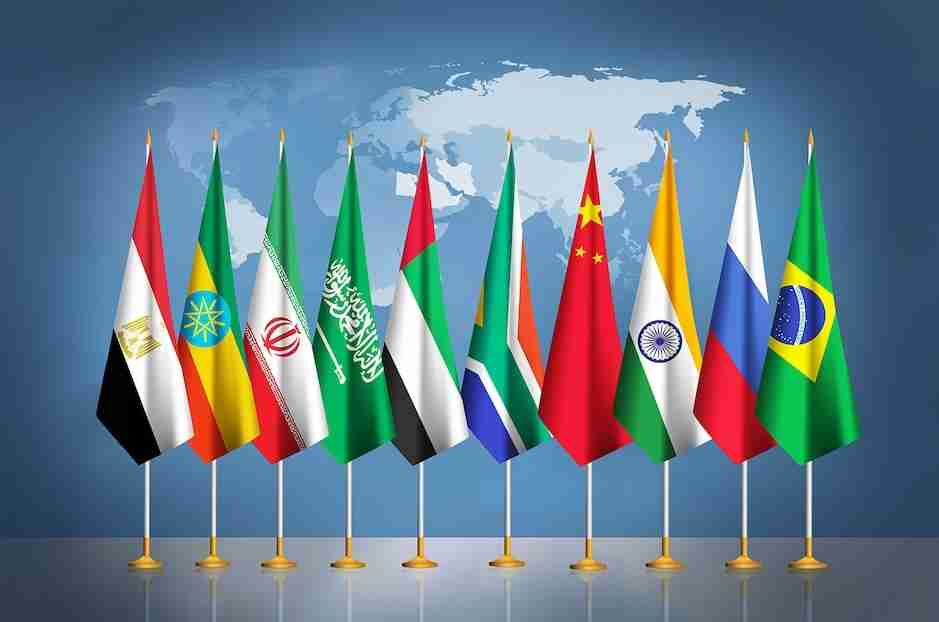
1] Introduction
The BRICS bloc – originally Brazil, Russia, India, China (the “BRIC” coined by Jim O’Neill in 2001), later joined by South Africa – has evolved from an acronym into a geopolitical coalition of emerging powers. In recent years, BRICS has embarked on an expansionary path and intensified efforts to challenge the dollar-centric global financial order. This article examines the theoretical underpinnings of BRICS’ formation, expansion, and financial initiatives through the lenses of international relations and political economy.


2] Origins and Geopolitical Rationale of BRICS
Early on, BRICS advocated reforming global financial governance. This reflected a cooperative, reformist impulse. Not to antagonize the West, but to offer an alternative voice within an order long dominated by the West.
BRICS’ creation can also be interpreted as an attempt by emerging countries to institutionalize their cooperation, without relying on a Western benevolence. Keohane’s concept of “cooperation after hegemony” argues that states can build regimes and norms to serve common interests when hegemonic leadership is absent or distrusted. BRICS exemplifies this.
Critical theories like Immanuel Wallerstein’s world-systems analysis or dependency theory cast BRICS in another light – as a rebellion of the semi-periphery against core dominance. By uniting, they sought to amplify the voice of the Global South and contest the rules set by the traditional core powers. Indeed, Brazilian President Lula da Silva lamented that under the current system “emerging and developing economies fund the developed world.”


3] Phases and Drivers for BRICS Expansion
For more than a decade, BRICS remained a relatively exclusive club of five countries. After South Africa’s entry in 2010, no new members were added throughout the 2010s. Only recently has BRICS initiated a major expansion with inclusion of Egypt, Ethiopia, Iran, and the UAE in 2023, and in January 2025, Indonesia.
This marks a significant shift from the earlier cautious approach to membership. Why did BRICS long remain closed, and why now the sudden surge of enlargement? Several theoretical frameworks shed light on these questions:
Initially, keeping BRICS small may have been about maintaining a balance among the founding members. Admitting new powers might align BRICS more closely with Chinese or Russian agendas, potentially at Brazil or India’s expense. The reluctance shows a classic balance-of-power concern– a desire to prevent any one member from dominating the group through added allies or economic leverage.
The global context by the 2020s provided new incentives for expansion. During the recent pandemic (Covid-19), many developing nations felt let down by the hoarding of vaccines and “structural disadvantages” in crisis response.
The dramatic Western sanctions on Russia after 2022 and the U.S.–China strategic rivalry have made it attractive for countries in the Global South to hedge their bets and join a bloc not aligned with the West. U.S. pressure and the perceived use of the dollar and sanctions as geopolitical weapons pushed even neutral countries to consider BRICS membership as a way to diversify their partnerships and gain some insulation from Western dominance.
The international system has noticeably shifted toward multipolarity. U.S. unipolar dominance is receding, and it is making the last ditch effort under present administration. As the dominant power’s relative position erodes, secondary states have greater incentive to bandwagon together for protection or influence.
That said, expansion also brings new challenges. A larger BRICS is more heterogeneous – including rivalries like Iran vs. UAE or varied political systems – which could make consensus harder. With many members, it risks internal fractures or a slower decision-making. The BRICS also must balance between those pushing a more anti-West stance (China, Russia, now Iran) and those preferring a more moderate, reformist posture (India, Brazil, South Africa).
4] The Strategic Direction of BRICS
Looking ahead, BRICS’ strategic direction likely involves walking a fine line: pushing for changes in the global system that favour multipolarity, while not formalizing into a rigid bloc that forces countries to choose sides.
In practice, we see BRICS pursuing initiatives like: expanding trade in local currencies – to reduce dollar dependence, cooperating on technology and energy to avoid Western chokepoints, and championing reforms at the UN/IMF/WTO to give developing countries more voice.
It is also suggested that if U.S.-China rivalry worsens, and the if USA’s confrontational policies continue, BRICS could harden into an anti-West axis. The president Trump is openly hostile to BRICS and it might “force middle powers to choose” between BRICS and Western alignment.
On the other hand, most BRICS members do not want a new Cold War-style bifurcation. They value strategic autonomy and will resist being subsumed into a China-Russia anti-West front. India and South Africa frequently reiterate non-alignment; even as they deepen BRICS ties, they engage the West on other fronts. This suggests BRICS’ likely path, as suggested earlier, is a nuanced one: assertive in seeking alternatives to Western dominance, but careful to avoid formal hostility or military alignment.
As said by Indian Prime Minister PM Modi, “BRICS is not an anti-Western group, it’s just a non-Western group’.


5] Prospects of a BRICS Currency and the Status of BRICS Pay
One of the most provocative ideas circulating around BRICS is the creation of a common BRICS currency – an alternative to the U.S. dollar. Additionally, BRICS countries are actively developing a digital payments system (“BRICS Pay”) to facilitate trade in their own currencies.
A] The Idea of a BRICS Currency
Talk of a unified BRICS currency largely stems from the desire to accelerate de-dollarization and strengthen economic ties. Brazilian President Lula has been one of the vocal proponents of BRICS currency. Russian leaders likewise showed enthusiasm, especially after sanctions cut Russia off from the dollar system; a BRICS currency appeals to Moscow as part of building a sanctions-proof alternative.
Despite the chatter, no concrete plan for an actual common currency has emerged to date. There are significant hurdles which make the prospect doubtful in the near term.
Each BRICS nation values control over its own currency and monetary policy. Unlike the Eurozone countries – which are geographically proximate, politically aligned democracies with similar levels of development – BRICS members have vastly different economies and political systems. Coordinating a single currency would require ceding sovereignty to a supranational monetary authority, which seems improbable. The Euro’s creation was the culmination of decades of integration and trust-building; BRICS lacks that depth of integration or trust.
Furthermore, even within BRICS, China looms disproportionately (its GDP is larger than all others combined). A BRICS currency might in practice be dominated by the Chinese yuan or Beijing’s monetary stance, which India or Brazil would not accept. In fact, India has been notably cool on the idea of a BRICS currency, prioritizing its own rupee internationalization instead.
Thus, BRICS governments currently favour de-dollarization via local currencies over creating a brand-new currency. This strategy is sometimes called the “R5 initiative,” referring to the five BRICS currencies all coincidentally starting with R (Real, Ruble, Rupee, Renminbi, Rand).
The idea is to encourage trade among BRICS to be settled in these currencies rather than USD. Indeed, with the addition of new members, more currencies (Saudi riyal, etc.) join the mix, but the principle remains to “prioritize use of BRICS+ currencies over the U.S. dollar in intra-BRICS activities”. This is a more pragmatic approach to currency cooperation – essentially a currency bloc without a single currency, where multiple national currencies are interoperable for trade and finance.


B] BRICS Pay
A crucial enabler for a local-currency bloc is the BRICS Pay system. BRICS Pay connects central banks of BRICS countries and allows seamless cross-border payments in each other’s currencies. Technically, it is blockchain-based decentralized system where participating banks (or users) operate with no central hub – making it resistant to external control. In essence, BRICS Pay is a tool to bypass Western-controlled networks, like the Brussels-based SWIFT payment system.
By enabling direct communication between BRICS financial institutions, BRICS Pay would allow, say, a South African importer to pay a Indian exporter in rupees, routed through a BRICS Pay channel, without touching the U.S.-dominated correspondent banking system. This is strategically significant: it reduces exposure to sanctions and transaction costs in dollar conversions.
The 2024 Kazan Declaration explicitly endorsed exploring “cross-border payment instruments” and local currency use. BRICS Pay is thus on track to become an operational reality within few years.
The implication for the dollar is that it could lose its intermediary role in a growing volume of transactions within this bloc. It would effectively create a parallel financial circuitry insulated from Western oversight, a tangible form of financial multipolarity.
C] Trade in BRICS Currencies vs. USD
Presently, neither the euro nor the currencies of BRICS nations have yet made a significant dent in global reliance on the dollar. The U.S. dollar’s share of official foreign exchange reserves is still about 55% (as of early 2024), with the euro around 20%. The Chinese renminbi, despite China’s economic size, accounts for only roughly 2–3% of global reserves.
However, when we narrow focus to intra-BRICS or BRICS-to-partner trade, the share of local currencies is slowly rising. Russia-China trade has seen a dramatic swing toward settlement in rubles and yuan since 2022, after Western sanctions on Russia. Similarly, India has begun settling some of its oil purchases from Russia in Indian rupees and UAE dirhams, and India and UAE recently agreed to use rupees for trade in a limited scope.
If BRICS Pay becomes operational by 2025-26, we might see a leap in local currency usage as the barrier of payment processing will be lowered.
This could gradually carve out a multi-currency system where, instead of one dominant global currency, there are regional spheres: a dollar zone, a yuan zone, perhaps a euro zone – and countries choosing which to use based on context. Some scholars describe the possibility of an emerging “currency pluralism”.
6] Trump’s Tariff Threats
The discussion of BRICS currency plans took a dramatic turn with the return of Donald Trump to the U.S. presidency. In early 2025, Trump warned that if BRICS members tried to create a new currency or replace the dollar’s reserve role, the U.S. would retaliate with 100% tariffs on their exports. In his own words, “Any Country that tries [to replace the USD] should say hello to Tariffs, and goodbye to America!”.
Offensive realism as given by John Mearsheimer, posits that great powers are always seeking opportunities to gain power at the expense of others, and they fear the rise of peer competitors. A hegemonic power, in this view, will go to great lengths – including aggressive means – to maintain its dominance.
As John Mearsheimer predicts, “the hegemon will not concede its position gracefully but will rather coerce or punish those who challenge it”.
Notably, Russia responded that any U.S. attempt to force dollar use would “backfire”, which indeed is consistent with realist security dilemmas – coercion can provoke countermeasures. Such threats perhaps could drive BRICS closer together. This feedback loop is exactly what realism would foresee in a power transition rivalry.
7] De-dollarization and Dollar Devaluation
De-dollarization refers to reducing the global economy’s reliance on the U.S. dollar – in reserves, in trade, and in finance. For decades, the dollar has been the ubiquitous lubricant of globalization, often comprising 60-70% of central bank reserves, invoicing more than 50% of international trade, and being on one side of ~88% of forex transactions.
This bestows the U.S. with what former French President Valéry d’Estaing (aka VDE) called an “exorbitant privilege” – the ability to print currency for the world, run deficits without immediate crises, and exert influence (the U.S. can sanction countries by restricting dollar access, as seen with Iran and Russia). Naturally, many countries chafe at this dollar dominance and the implicit U.S. hegemony it represents.
De-dollarization thus has a theoretical appeal rooted in sovereignty and equality: a more multipolar currency order could dilute U.S. power and be more stable if it better reflects the current distribution of economic power.
From a world-systems or dependency perspective, the dollar-centric system is part of core (U.S.) dominance. Periphery nations often have to adjust their economies to U.S. monetary policy (when the Fed raises rates, emerging markets suffer capital outflows, for instance).
De-dollarization is seen as a path to escape that dependency, allowing countries to regain monetary sovereignty – control over one’s currency and not being overly subject to another country’s currency decisions.
There’s also the notion of the Triffin Dilemma: the issuer of the global reserve currency must supply the world with liquidity (dollars) which often means running trade deficits, but over time this can undermine confidence in the currency’s value. The U.S. has managed this dilemma so far, but with growing national debt.
A] Impracticality of De-dollarization
Despite increased chatter, full-scale de-dollarization remains difficult due to multiple structural reasons:
The dollar is deeply entrenched – it’s accepted everywhere, from a bank in Kenya to an oil deal in Tokyo. This network effect means everyone uses dollars because everyone else does, which creates immense inertia. The U.S. capital markets are by far the deepest and most liquid.
International currency status ultimately relies on trust – trust that the currency will hold value (low inflation), and that it will be widely accepted by others. The U.S. has a long track record of providing a stable currency. In contrast, other contenders have issues: the Euro had/has internal crises (e.g. eurozone debt crisis) and lacks a unified fiscal authority. The Chinese Yuan (Renminbi) is tightly managed; China doesn’t allow free capital flow and could freeze assets in political disputes (just as the U.S. does via sanctions – so some might say “why trade one risk for another?”).
So, ironically, while U.S. sanctions push people away from the dollar, Chinese alignment with Russia or potential conflict over Taiwan makes them wary of the yuan – a catch-22.
Additionally, many emerging economies have dollar-denominated debt; True de-dollarization would involve restructuring debt into other currencies too, which creditors might resist unless there’s a clear benefit.
The U.S. will not sit idle either, as we’ve seen with Trump’s threats. There is also peer pressure: some allies may hesitate to join de-dollarization initiatives for fear of U.S. retaliation or because they still see value in the U.S.-led system.
With fiat currency dominance being questioned, some suggest a return to gold or commodity baskets. Gold is seen as a neutral reserve asset as no country can block your gold in your vaults. However, gold as a currency for trade is impractical – it’s not easily divisible for transactions, using it as backing still means you need to fix conversion rates, and its supply remains limited.


B] Dollar Devaluation
Amid these trends, it’s reported that Donald Trump’s administration (in 2025) has considered actively weakening the dollar’s value to address U.S. trade deficits – a proposal dubbed the “Mar-a-Lago Accord” . Its core goal is to devalue the dollar while preserving its role as the world reserve currency, a careful balancing act intended to avoid the contradictions described in the Triffin paradox.
However economist like Kenneth Rogoff note that, this strategy is flawed and “could make it too expensive for Americans to import, and it undermines faith in the dollar long-term. Another economist Jeffrey Frankel argues that the way Trump is considering weakening the dollar “would almost certainly spell the end of the U.S. dollar’s reign as the dominant international currency.”. Overt politicization of the dollar’s value could cause investors and central banks to diversify away, no longer seeing the dollar as a reliable store of value.
From a hegemonic stability viewpoint, a controlled decline of the dollar to a new equilibrium might be manageable, but if miscalculated, it could cause disorder in markets and weaken the pillar of U.S. financial hegemony – trust in the dollar.
However, it’s also possible this talk is a bargaining chip or populist posturing by Trump. If USA actually tries to devalue, the outcome could be chaotic.
Unless there’s a seismic event (e.g., a U.S. debt default or hyperinflation, which are unlikely but not impossible in far future), de-dollarization will likely be incremental. Efforts like BRICS Pay, local currency swaps, and perhaps Trump’s own unpredictable policies will harm dollar dominance. But for now, the twin anchors of U.S. economic/military might and the lack of a ready replacement mean the dollar-centric system will persist. In effect, the international political economy is stuck with what one might call the least-unattractive hegemon’s currency. The structural power of the dollar – embedded in contracts, central bank habits, and even people’s psyche– is formidable.
8] Conclusion
The interplay of BRICS expansion, de-dollarization, and potential BRICS currency moves is at the heart of the evolving international political economy.
Using theories from realism to world-systems, we see a coherent narrative: Rising powers are pushing back against an aging hegemon. They are employing institutional innovations and economic strategies to secure a more multipolar system. The U.S., especially under nationalist leadership, is responding forcefully, which could either reassert its dominance or accelerate the birth of a new order.
The concepts like multipolarity, balance of power, and dependency are no longer abstract – they are manifest in BRICS’ initiatives and the global reactions they spark. The next decade will likely prove critical in determining if the BRICS can translate their combined potential into a sustained realignment of the global financial architecture, or if the dollar-centric order will adapt and endure despite the challengers.
For a student of international relations, these developments offer a real-time case study of theory meeting practice on the world stage – a reminder that the evolution of global order is an ongoing and dynamic process, driven by both power and ideas.
9] References
- Reuters – “Indonesia joins BRICS bloc as full member, Brazil says”
- Carnegie Endowment – “BRICS Expansion and the Future of World Order” (Stewart et al., 2025)
- Reuters – “Trump repeats tariffs threat to dissuade BRICS nations from replacing US dollar”
- Reuters – “Brazil’s Lula urges BRICS to create alternative payment methods”
- Atlantic Council/StratNewsGlobal – “US Dollar Remains World’s Primary Reserve Currency: Atlantic Council Study”
- Project Syndicate – Jeffrey Frankel, “Is Trump Engineering the Decline and Fall of the Dollar?”
- The Guardian – Kenneth Rogoff, “Why Donald Trump’s plan to weaken the dollar is flawed”


Excellent analysis!